
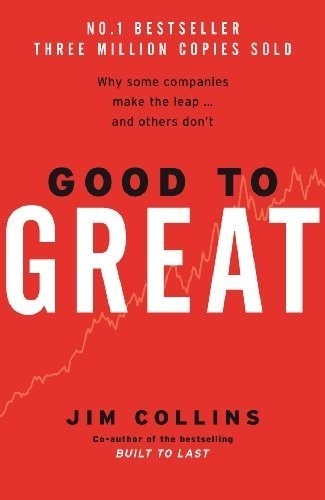
Good To Great : Why Some Companies Make The Leap and Others Don’t
5.300,00 د.ج
This carefully researched and well-written book disproves most of the current management hype-from the cult of the superhuman CEO to the cult of IT to the acquisitions and merger mania. It will not enable mediocrity to become competence. But it should enable competence to become excellence.
1
Item sold in last 3 days
0
People watching this product now!
Estimated delivery dates: juin 11, 2026 – juin 18, 2026

Description
This carefully researched and well-written book disproves most of the current management hype-from the cult of the superhuman CEO to the cult of IT to the acquisitions and merger mania. It will not enable mediocrity to become competence. But it should enable competence to become excellence.
Produits similaires
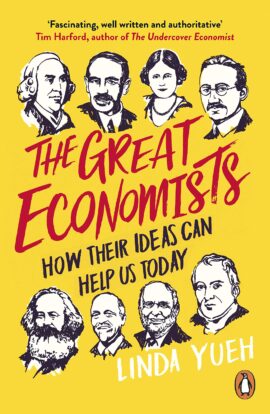
Great Economists
A Times Best Business Book of 2018What can the ideas of history's greatest economists tell us about the most important issues of our time?'The best place to start to learn about the very greatest economists of all time' Professor Tyler Cowen, author of The Complacent Class and The Great StagnationSince the days of Adam Smith, economists have grappled with a series of familiar problems - but often their ideas are hard to digest, before we even try to apply them to today's issues. Linda Yueh is renowned for her combination of erudition, as an accomplished economist herself, and accessibility, as a leading writer and broadcaster in this field: and in The Great Economists she explains the key thoughts of history's greatest economists, how their lives and times affected their ideas, how our lives have been influenced by their work, and how they could help with the policy challenges that we face today.In the light of current economic problems, and in particular economic growth, Yueh explores the thoughts of economists from Adam Smith and David Ricardo through Joan Robinson and Milton Friedman to Douglass North and Robert Solow. Along the way she asks, for example: what do the ideas of Karl Marx tell us about the likely future for the Chinese economy? How does the work of John Maynard Keynes, who argued for government spending to create full employment, help us think about state investment? And with globalization in trouble, what can we learn about handling Brexit and Trumpism?In one accessible volume, this expert new voice provides an overarching guide to the biggest questions of our time.The Great Economists includes:Adam SmithDavid RicardoKarl MarxAlfred MarshallIrving FisherJohn Maynard KeynesJoseph SchumpeterFriedrich HayekJoan RobinsonMilton FriedmanDouglass NorthRobert Solow'Economics students, like others, can learn a lot from this book' - Professor Paul Collier, author of The Bottom Billion'Not only a great way to learn in an easily readable manner about some of the greatest economic influences of the past, but also a good way to test your own a priori assumptions about some of the big challenges of our time.' - Lord Jim O'Neill, former Chairman at Goldman Sachs Asset Management, former UK Treasury Minister, and author of The Growth Map'An extremely engaging survey of the lifetimes and ideas of the great thinkers of economic history.' - Professor Kenneth Rogoff, author of The Curse of Cash and co-author of This Time is Different'This book is a very readable introduction to the lives and thinking of the greats.' - Professor Raghuram Rajan, former Governor of the Reserve Bank of India, and author of I Do What I Do and Fault Lines'Read it not only to learn about the world's great economists, but also to see how consequential thought innovations can be, and have been.' - Mohamed el-Erian, Chief Economic Adviser at Allianz, former CEO of PIMCO
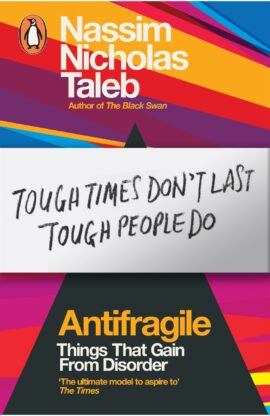
Antifragile
Paperback. Pub Date :2013-06-06 Pages: 544 Language: English Publisher: Penguin Books The hottest thinker in the world Bryan Appleyard. Sunday TimesIn The Black Swan. Taleb showed us that highly improbable and unpredictable events underlie almost everything about our world ... Here Taleb stands uncer-tainty on its head. making it desirable. even necessary The antifragile is beyond the resilient or robust The resil-ient resists shocks and stays the same: the antifragile gets better and better.Just as human bones get stronger when subjected to stress and tension. many things in life benefit from stress. disorder. volatility. and turmoil. What Taleb has identified and calls antifragile are things that not only gain from chaos but need it in order to survive and flourish.Whats more . the antifragile is immune to prediction errors and protected from adverse events. Why is the cit...
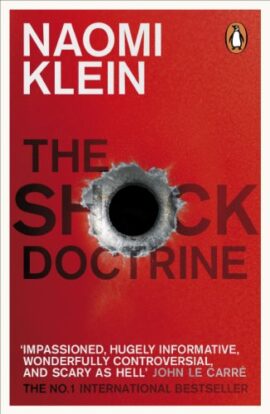
The Shock Doctrine: The Rise of Disaster Capitalism
Around the world in Britain, the United States, Asia and the Middle East, there are people with power who are cashing in on chaos: exploiting bloodshed and catastrophe to brutally remake our world in their image. They are the shock doctors. Thrilling and revelatory, "The Shock Doctrine" cracks open the secret history of our era. Exposing these global profiteers, Naomi Klein discovered information and connections that shocked even her about how comprehensively the shock doctors' beliefs now dominate our world - and how this domination has been achieved. Raking in billions out of the tsunami, plundering Russia, exploiting Iraq - this is the chilling tale of how a few are making a killing while more are getting killed.
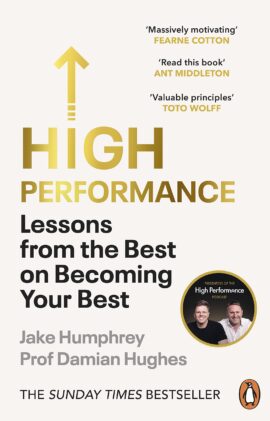
High Performance
The phenomenal Sunday Times bestseller'Massively motivating' Fearne Cotton'A wealth of wisdom' Vex King'Read this book' Ant Middleton High performance isn't born. It's made. This book uncovers the eight essential habits of the world's leading sportspeople, coaches and entrepreneurs. From taking responsibility for your situation to finding your 'Trademark Behaviours', it reveals how the world's highest-achieving people unlocked their potential - and how you can too. Anyone can learn the secrets of high performance.'Full of valuable principles with real-world relevance to people's everyday lives' Toto Wolff'So many different lessons from so many remarkable people' Adam Peaty Drawing on conversations with... Dina Asher-Smith | Steven Bartlett | Tom Daley | Steven Gerrard | Evelyn Glennie | Ole Gunnar Solskjaer | Kelly Holmes | Chris Hoy | Eddie Jones | Siya Kolisi | Frank Lampard | Jo Malone | Matthew McConaughey | Ant Middleton | Tracey Neville | Robin Van Persie | Mauricio Pochettino | Gareth Southgate | Holly Tucker | Jonny Wilkinson | Clive Woodward | Toto Wolff and many more...
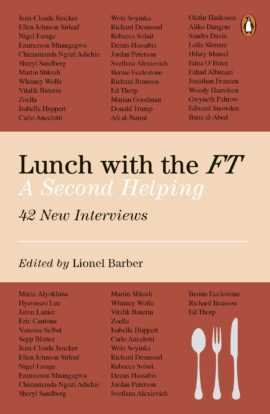
Lunch with the FT: A Second Helping
Lunch with the Financial Times has been a permanent fixture in the Financial Times for almost 25 years, featuring presidents, film stars, musical icons and business leaders from around the world. The column is now as well-established institution which has reinvigorated the art of conversation in the convivial, intimate environment of a long boozy lunch. On its 25th anniversary, Lunch with the Financial Times 2 will showcase the most entertaining, incisive and fascinating interviews from the past five years including those with Donald Trump, Sheryl Sandberg, Richard Branson, Yanis Varoufakis, Zadie Smith, Nigel Farage, Russell Brand and David Guetta, illustrated in full colour with James Ferguson's famous portraits.
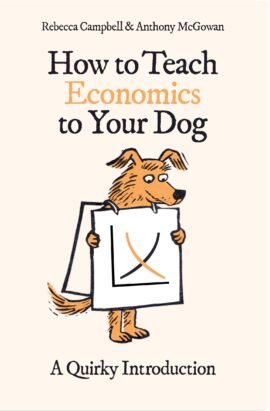
How to Teach Economics to Your Dog: A Quirky Introduction
A fun take on some of the biggest questions in economics, made accessible for non-experts (and dogs)Monty is a dog, not a financial genius, but economics still shapes his everyday life.Over the course of seventeen walks, Dr Rebecca Campbell chews over economic concepts and investigates how they apply to our lives – people and mutts alike. There are no graphs, no charts (Monty can’t read them) and definitely no calculus!How to Teach Economics to Your Dog tackles the knotty question of what economics actually is. Is it a mathematical science like physics? Or a moral and philosophical investigation of how societies should manage scarce resources?Along the way we meet some of the great thinkers from Adam Smith to Thomas Piketty, and ponder questions such as: What on earth does quantitative easing mean? And why are some countries so much richer than others?
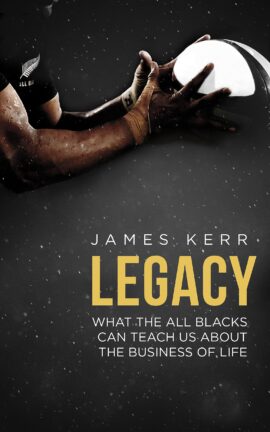
Legacy: What The All Blacks Can Teach Us About The Business Of Life
THE 10TH ANNIVERSARY EDITIONChampions do extra.They sweep the sheds.They follow the spearhead.They keep a blue head.They are good ancestors.In Legacy, best-selling author James Kerr goes deep into the heart of the world's most successful sporting team, the legendary All Blacks of New Zealand, to reveal 15 powerful and practical lessons for leadership and business.Legacy is a unique, inspiring handbook for leaders in all fields, and asks: What are the secrets of success - sustained success? How do you achieve world-class standards, day after day, week after week, year after year? How do you handle pressure? How do you train to win at the highest level? What do you leave behind you after you're gone?What will be your legacy?
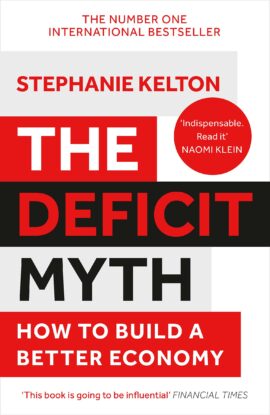
The Deficit Myth: Modern Monetary Theory and How to Build a Better Economy
THE INTERNATIONAL BESTSELLER'Kelton has succeeded in instigating a round of heretical questioning, essential for a post-Covid-19 world, where the pantheon of economic gods will have to be reconfigured' Guardian'Stephanie Kelton is an indispensable source of moral clarity ... the truths that she teaches about money, debt, and deficits give us the tools we desperately need to build a safe future for all' Naomi Klein'Game-changing ... Read it!' Mariana Mazzucato'A rock star in her field' The Times'This book is going to be influential' Financial Times'Convincingly overturns conventional wisdom' New York TimesSupporting the economy, paying for healthcare, creating new jobs, preventing a climate apocalypse: how can we pay for it all? Leading economic thinker Stephanie Kelton, shows how misguided that question is, and how a radical new approach can maximise our potential as a society. Everything that we've been led to believe about deficits and the role of money and government spending is wrong. Rather than asking the self-defeating question of how to pay for the crucial improvements our society needs, Kelton guides us to ask: which deficits actually matter?