
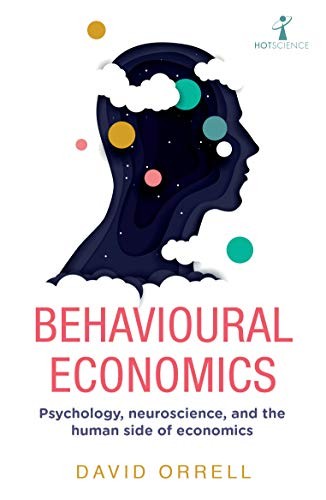
Behavioural Economics: Psychology, neuroscience, and the human side of economics
2.600,00 د.ج
The controversial science that claims to have revolutionised economics.
For centuries, economics was dominated by the idea that we are rational individuals who optimise our own ‘utility’. Then, in the 1970s, psychologists demonstrated that the reality is a lot messier. We don’t really know what our utility is, and we care about people other than ourselves. We are susceptible to external nudges. And far from being perfectly rational we are prone to ‘cognitive biases’ with complex effects on decision-making, such as forgetting to prepare for retirement.
David Orrell explores the findings from psychology and neuroscience that are shaking up economics – and that are being exploited by policy-makers and marketers alike, to shape everything from how we shop for food, to how we tackle societal happiness or climate change. Finally, he asks: is behavioural economics a scientific revolution, or just a scientific form of marketing?

The controversial science that claims to have revolutionised economics.
For centuries, economics was dominated by the idea that we are rational individuals who optimise our own ‘utility’. Then, in the 1970s, psychologists demonstrated that the reality is a lot messier. We don’t really know what our utility is, and we care about people other than ourselves. We are susceptible to external nudges. And far from being perfectly rational we are prone to ‘cognitive biases’ with complex effects on decision-making, such as forgetting to prepare for retirement.
David Orrell explores the findings from psychology and neuroscience that are shaking up economics – and that are being exploited by policy-makers and marketers alike, to shape everything from how we shop for food, to how we tackle societal happiness or climate change. Finally, he asks: is behavioural economics a scientific revolution, or just a scientific form of marketing?
Produits similaires
The Future of Geography
the new frontier, a wild and lawless place. It is already central to communication, economics, military strategy and international relations on Earth. Now, it is the latest arena for human exploration, exploitation – and, possibly, conquest. We’re heading up and out, and we’re taking our power struggles with us. China, the USA and Russia are leading the way.
From physical territory and resources to satellites, weaponry and strategic choke points, geopolitics is as important in the skies above us as it is down below. If you’ve ever wondered if humans are going back to the Moon, who will benefit from exploration or what space wars might look like, the answers are here.
With all the insight and wit that have made Tim Marshall the UK’s most popular writer on geopolitics, this gripping book shows how we got here and where we’re going, covering great-power rivalry; technology; commerce; combat in space; and what it means for all of us down here on Earth. This is essential reading on power, politics and the future of humanity.

Everything Is F*cked: A Book About Hope
“Just because everything appears to be a mess doesn’t mean you have to be one. Mark Manson’s book is a call to arms for a better life and better world and could not be more needed right now.” — Ryan Holiday, bestselling author of The Obstacle is the Way and Ego is the Enemy
From the author of the international mega-bestseller The Subtle Art of Not Giving A F*ck comes a counterintuitive guide to the problems of hope.
We live in an interesting time. Materially, everything is the best it’s ever been—we are freer, healthier and wealthier than any people in human history. Yet, somehow everything seems to be irreparably and horribly f*cked—the planet is warming, governments are failing, economies are collapsing, and everyone is perpetually offended on Twitter. At this moment in history, when we have access to technology, education and communication our ancestors couldn’t even dream of, so many of us come back to an overriding feeling of hopelessness.
What’s going on? If anyone can put a name to our current malaise and help fix it, it’s Mark Manson. In 2016, Manson published The Subtle Art of Not Giving A F*ck, a book that brilliantly gave shape to the ever-present, low-level hum of anxiety that permeates modern living. He showed us that technology had made it too easy to care about the wrong things, that our culture had convinced us that the world owed us something when it didn’t—and worst of all, that our modern and maddening urge to always find happiness only served to make us unhappier. Instead, the “subtle art” of that title turned out to be a bold challenge: to choose your struggle; to narrow and focus and find the pain you want to sustain. The result was a book that became an international phenomenon, selling millions of copies worldwide while becoming the #1 bestseller in 13 different countries.
In Everthing Is F*cked, Manson turns his gaze from the inevitable flaws within each individual self to the endless calamities taking place in the world around us. Drawing from the pool of psychological research on these topics, as well as the timeless wisdom of philosophers such as Plato, Nietzsche, and Tom Waits, he dissects religion and politics and the uncomfortable ways they have come to resemble one another. He looks at our relationships with money, entertainment and the internet, and how too much of a good thing can psychologically eat us alive. He openly defies our definitions of faith, happiness, freedom—and even of hope itself.
With his usual mix of erudition and where-the-f*ck-did-that-come-from humor, Manson takes us by the collar and challenges us to be more honest with ourselves and connected with the world in ways we probably haven’t considered before. It’s another counterintuitive romp through the pain in our hearts and the stress of our soul. One of the great modern writers has produced another book that will set the agenda for years to come.
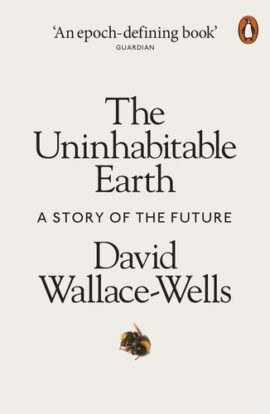
The Uninhabitable Earth: A Story of the Future
'An epoch-defining book' Matt Haig
'If you read just one work of non-fiction this year, it should probably be this' David Sexton, Evening Standard
It is worse, much worse, than you think.
The slowness of climate change is a fairy tale, perhaps as pernicious as the one that says it isn't happening at all, and if your anxiety about it is dominated by fears of sea-level rise, you are barely scratching the surface of what terrors are possible, even within the lifetime of a teenager today.
Over the past decades, the term "Anthropocene" has climbed into the popular imagination - a name given to the geologic era we live in now, one defined by human intervention in the life of the planet. But however sanguine you might be about the proposition that we have ravaged the natural world, which we surely have, it is another thing entirely to consider the possibility that we have only provoked it, engineering first in ignorance and then in denial a climate system that will now go to war with us for many centuries, perhaps until it destroys us. In the meantime, it will remake us, transforming every aspect of the way we live-the planet no longer nurturing a dream of abundance, but a living nightmare.
The Mind’s Eye
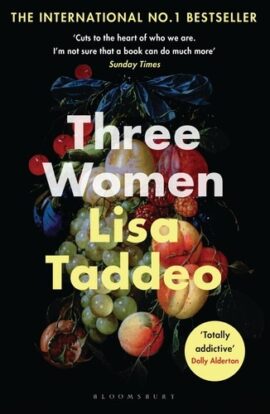
Three Women: A BBC 2 Between the Covers Book Club Pick
All Maggie wanted was to be understood. How did she end up in a relationship with her teacher and then in court, a hated pariah in her small town?
All Sloane wanted was to be admired. How did she end up a sexual object of men, including her husband, who liked to watch her have sex with other men and women?
Three Women is a record of unmet needs, unspoken thoughts, disappointments, hopes and unrelenting obsessions.