
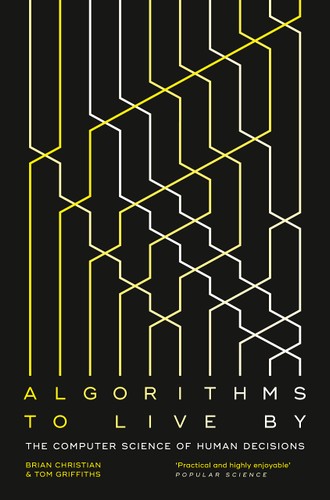
Algorithms to Live By: The Computer Science of Human Decisions
2.500,00 د.ج
What should we do, or leave undone, in a day or a lifetime? How much messiness should we accept? What balance of the new and familiar is the most fulfilling? These may seem like uniquely human quandaries, but they are not. Computers, like us, confront limited space and time, so computer scientists have been grappling with similar problems for decades. And the solutions they’ve found have much to teach us.
In a dazzlingly interdisciplinary work, Brian Christian and Tom Griffiths show how algorithms developed for computers also untangle very human questions. They explain how to have better hunches and when to leave things to chance, how to deal with overwhelming choices and how best to connect with others. From finding a spouse to finding a parking spot, from organizing one’s inbox to peering into the future, Algorithms to Live By transforms the wisdom of computer science into strategies for human living.

What should we do, or leave undone, in a day or a lifetime? How much messiness should we accept? What balance of the new and familiar is the most fulfilling? These may seem like uniquely human quandaries, but they are not. Computers, like us, confront limited space and time, so computer scientists have been grappling with similar problems for decades. And the solutions they’ve found have much to teach us.
In a dazzlingly interdisciplinary work, Brian Christian and Tom Griffiths show how algorithms developed for computers also untangle very human questions. They explain how to have better hunches and when to leave things to chance, how to deal with overwhelming choices and how best to connect with others. From finding a spouse to finding a parking spot, from organizing one’s inbox to peering into the future, Algorithms to Live By transforms the wisdom of computer science into strategies for human living.
Produits similaires

In Cold Blood
An alternate cover of this ISBN can be found here.
An Anthropologist on Mars

We Should All Be Feminists
What does “feminism” mean today? That is the question at the heart of We Should All Be Feminists, a personal, eloquently-argued essay – adapted from her much-viewed Tedx talk of the same name – by Chimamanda Ngozi Adichie, the award-winning author of ‘Americanah’ and ‘Half of a Yellow Sun’. With humour and levity, here Adichie offers readers a unique definition of feminism for the twenty-first century – one rooted in inclusion and awareness. She shines a light not only on blatant discrimination, but also the more insidious, institutional behaviours that marginalise women around the world, in order to help readers of all walks of life better understand the often masked realities of sexual politics. Throughout, she draws extensively on her own experiences – in the U.S., in her native Nigeria – offering an artfully nuanced explanation of why the gender divide is harmful for women and men, alike. Argued in the same observant, witty and clever prose that has made Adichie a best-selling novelist, here is one remarkable author’s exploration of what it means to be a woman today – and an of-the-moment rallying cry for why we should all be feminists.
Musicophilia: Tales of Music and the Brain
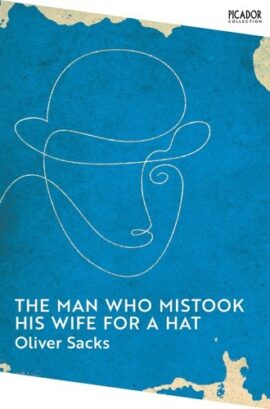
The Man Who Mistook His Wife for a Hat
If a man has lost a leg or an eye, he knows he has lost a leg or an eye; but if he has lost a self – himself – he cannot know it, because he is no longer there to know it.
In this extraordinary book, Dr. Oliver Sacks recounts the stories of patients struggling to adapt to often bizarre worlds of neurological disorder. Here are people who can no longer recognize everyday objects or those they love; who are stricken with violent tics or shout involuntary obscenities, and yet are gifted with unusually acute artistic or mathematical talents. If sometimes beyond our surface comprehension, these brilliant tales illuminate what it means to be human.
A provocative exploration of the mysteries of the human mind, The Man Who Mistook His Wife for a Hat is a million-copy bestseller by the twentieth century's greatest neurologist.
Part of the Picador Collection, a series showcasing the best of modern literature.