
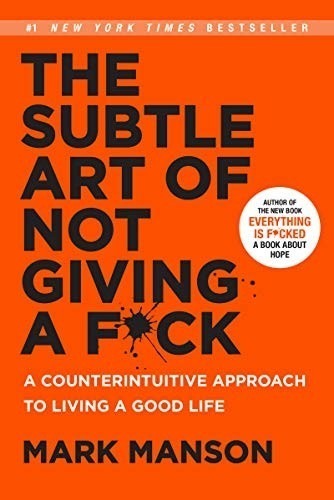

The Subtle Art of Not Giving a F*ck: A Counterintuitive Approach to Living a Good Life
4.400,00 د.ج
#1 New York Times Bestseller • More than 10 million Copies Sold
In this generation-defining self-help guide, a superstar blogger cuts through the crap to show us how to stop trying to be « positive » all the time so that we can truly become better, happier people.
For decades, we’ve been told that positive thinking is the key to a happy, rich life. « F**k positivity, » Mark Manson says. « Let’s be honest, shit is f**ked and we have to live with it. » In his wildly popular Internet blog, Manson doesn’t sugarcoat or equivocate. He tells it like it is—a dose of raw, refreshing, honest truth that is sorely lacking today. The Subtle Art of Not Giving a F**k is his antidote to the coddling, let’s-all-feel-good mindset that has infected modern society and spoiled a generation, rewarding them with gold medals just for showing up.
Manson makes the argument, backed both by academic research and well-timed poop jokes, that improving our lives hinges not on our ability to turn lemons into lemonade, but on learning to stomach lemons better. Human beings are flawed and limited— »not everybody can be extraordinary, there are winners and losers in society, and some of it is not fair or your fault. » Manson advises us to get to know our limitations and accept them. Once we embrace our fears, faults, and uncertainties, once we stop running and avoiding and start confronting painful truths, we can begin to find the courage, perseverance, honesty, responsibility, curiosity, and forgiveness we seek.
There are only so many things we can give a f**k about so we need to figure out which ones really matter, Manson makes clear. While money is nice, caring about what you do with your life is better, because true wealth is about experience. A much-needed grab-you-by-the-shoulders-and-look-you-in-the-eye moment of real-talk, filled with entertaining stories and profane, ruthless humor, The Subtle Art of Not Giving a F*ck is a refreshing slap for a generation to help them lead contented, grounded lives.

#1 New York Times Bestseller • More than 10 million Copies Sold
In this generation-defining self-help guide, a superstar blogger cuts through the crap to show us how to stop trying to be « positive » all the time so that we can truly become better, happier people.
For decades, we’ve been told that positive thinking is the key to a happy, rich life. « F**k positivity, » Mark Manson says. « Let’s be honest, shit is f**ked and we have to live with it. » In his wildly popular Internet blog, Manson doesn’t sugarcoat or equivocate. He tells it like it is—a dose of raw, refreshing, honest truth that is sorely lacking today. The Subtle Art of Not Giving a F**k is his antidote to the coddling, let’s-all-feel-good mindset that has infected modern society and spoiled a generation, rewarding them with gold medals just for showing up.
Manson makes the argument, backed both by academic research and well-timed poop jokes, that improving our lives hinges not on our ability to turn lemons into lemonade, but on learning to stomach lemons better. Human beings are flawed and limited— »not everybody can be extraordinary, there are winners and losers in society, and some of it is not fair or your fault. » Manson advises us to get to know our limitations and accept them. Once we embrace our fears, faults, and uncertainties, once we stop running and avoiding and start confronting painful truths, we can begin to find the courage, perseverance, honesty, responsibility, curiosity, and forgiveness we seek.
There are only so many things we can give a f**k about so we need to figure out which ones really matter, Manson makes clear. While money is nice, caring about what you do with your life is better, because true wealth is about experience. A much-needed grab-you-by-the-shoulders-and-look-you-in-the-eye moment of real-talk, filled with entertaining stories and profane, ruthless humor, The Subtle Art of Not Giving a F*ck is a refreshing slap for a generation to help them lead contented, grounded lives.
Produits similaires

The Uninhabitable Earth: A Story of the Future
'An epoch-defining book' Matt Haig
'If you read just one work of non-fiction this year, it should probably be this' David Sexton, Evening Standard
It is worse, much worse, than you think.
The slowness of climate change is a fairy tale, perhaps as pernicious as the one that says it isn't happening at all, and if your anxiety about it is dominated by fears of sea-level rise, you are barely scratching the surface of what terrors are possible, even within the lifetime of a teenager today.
Over the past decades, the term "Anthropocene" has climbed into the popular imagination - a name given to the geologic era we live in now, one defined by human intervention in the life of the planet. But however sanguine you might be about the proposition that we have ravaged the natural world, which we surely have, it is another thing entirely to consider the possibility that we have only provoked it, engineering first in ignorance and then in denial a climate system that will now go to war with us for many centuries, perhaps until it destroys us. In the meantime, it will remake us, transforming every aspect of the way we live-the planet no longer nurturing a dream of abundance, but a living nightmare.
Why We Can’t Sleep: Women’s New Midlife Crisis
Calhoun decided to find some answers. She looked into housing costs, HR trends, credit card debt averages and divorce data. At every turn, she saw a pattern: sandwiched between the Boomers and the Millennials, Gen X women were facing new problems as they entered middle age, problems that were being largely overlooked.
Speaking with women across America about their experiences as the generation raised to 'have it all,' Calhoun found that most were exhausted, terrified about money, under-employed, and overwhelmed. Instead of their issues being heard, they were told instead to lean in, take 'me-time' or make a chore chart to get their lives and homes in order.
In Why We Can't Sleep, Calhoun opens up the cultural and political contexts of Gen X's predicament and offers solutions for how to pull oneself out of the abyss - and keep the next generation of women from falling in. The result is reassuring, empowering and essential reading for all middle-aged women, and anyone who hopes to understand them.
When Breath Becomes Air: THE MILLION COPY BESTSELLER
When Breath Becomes Air chronicles Kalanithi’s transformation from a medical student asking what makes a virtuous and meaningful life into a neurosurgeon working in the core of human identity – the brain – and finally into a patient and a new father.

Dear Ijeawele, or a Feminist Manifesto in Fifteen Suggestions
A few years ago, Chimamanda Ngozi Adichie received a letter from a dear friend from childhood, asking how to raise her new baby girl a feminist.
Although she has written and spoken out widely about feminism, Adichie wasn't sure how to advise her friend Ijeawele. But as a person who'd babysat, had loved her nieces and nephews, and now, too, was the mother of a daughter herself, she thought she would try. So she sent Ijeawele a letter with some suggestions--15 in all--which she has now decided to share with the world.
Compelling, direct, wryly funny, and perceptive, Dear Ijeawele offers specifics on how we can empower our daughters to become strong, independent women. Here, too, are ways parents can raise their children--both sons and daughters--beyond a culture's limiting gender prescriptions. This short, sharp work rings out in Chimamanda's voice: infused with deep honesty, clarity, strength, and above all love. She speaks to the important work of raising a girl in today's world, and provides her readers with a clear proposal for inclusive, nuanced thinking. Here we have not only a rousing manifesto, but a powerful gift for all people invested in the idea of creating a just society--an endeavour now more urgent and important than ever.
A Higher Loyalty: Truth, Lies, and Leadership
Man’s Search For Meaning: The classic tribute to hope from the Holocaust
'A book to read, to cherish, to debate, and one that will ultimately keep the memories of the victims alive' John Boyne, author of The Boy in the Striped Pyjamas
A prominent Viennese psychiatrist before the war, Viktor Frankl was uniquely able to observe the way that both he and others in Auschwitz coped (or didn't) with the experience. He noticed that it was the men who comforted others and who gave away their last piece of bread who survived the longest - and who offered proof that everything can be taken away from us except the ability to choose our attitude in any given set of circumstances. The sort of person the concentration camp prisoner became was the result of an inner decision and not of camp influences alone. Frankl came to believe man's deepest desire is to search for meaning and purpose. This outstanding work offers us all a way to transcend suffering and find significance in the art of living.